Ask a seller in one of Capitol Hill's older brick buildings for the HOA's reserve study today, and you're entitled to know one exists. Washington law requires it. Ask for the full resale disclosure packet that spells out whether that reserve is actually healthy, and depending on when the building was formed, the seller may not be legally required to hand it over yet. That gap between "the document exists" and "the document must be shared" is new as of this year, and it's landing squarely on the part of Capitol Hill's housing stock that most buyers assume is the safe, affordable entry point.
That gap is also a decent metaphor for the whole neighborhood right now. Capitol Hill's headline number, a median sale price of $792,000 over the three months ending June 2026 according to Redfin, sounds like a single market moving 4.9 percent higher than a year earlier. It isn't a single market. It's two markets stapled together, moving at different speeds, governed increasingly by different rules, and heading toward a zoning decision later this year that will treat them differently again.
The number that doesn't hold together
Redfin's June 2026 snapshot shows homes selling after a median 21 days on market, up from 17 days a year earlier, with 95 homes sold that month compared to 115 the year before. Price per square foot sat at $607, down slightly year over year. Read as a single trend line, that looks like a market cooling by a hair while still gaining value. Read as two trend lines, it looks like something else entirely.
Split the inventory by property type and the picture changes:
| Single-family homes | Condos | |
|---|---|---|
| Typical price range | $1.1M to $1.5M | $500K to $700K |
| Months of supply | Roughly 2 months | Roughly 4 to 4.5 months |
| Market posture | Tight, still favors sellers | Loosening, favors buyers |
A blended 3.5 months of supply across the neighborhood sounds like a mild seller's market. It's actually a scarce, competitive market for detached houses sitting next to a softening, negotiable market for condos, and the median price of $792,000 is the arithmetic average of those two very different conversations. If you're comparing Capitol Hill to another neighborhood using that single number, you're comparing a blend that doesn't describe any specific home you'd actually buy.
For buyers, this matters immediately. If you're shopping detached houses, you're competing in a market with roughly half the supply of the condo segment, and the sale-to-list ratio sitting close to 99 percent tells you accurate pricing gets rewarded and overpricing gets punished fast. If you're shopping condos, you're shopping the side of the market with more room to negotiate, more time to think, and, increasingly, more paperwork to review before you sign anything.
The law that just changed what "affordable entry point" means
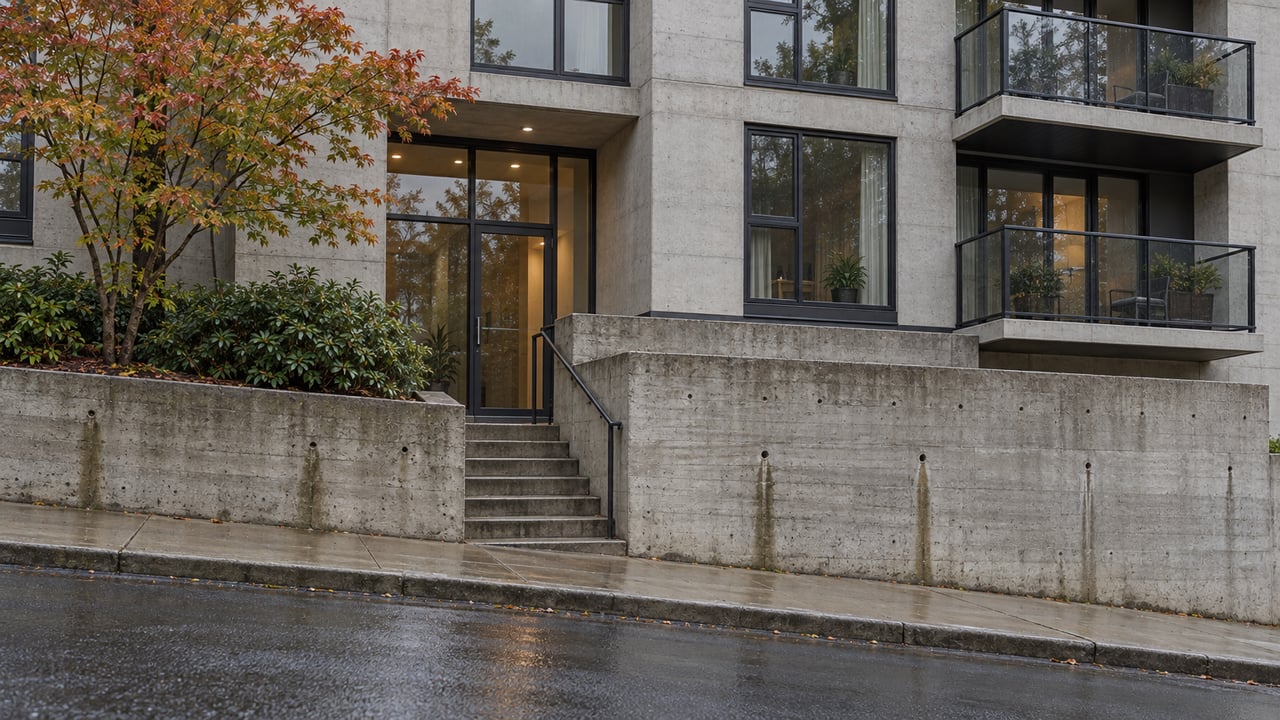
Capitol Hill's condo stock skews old. Blocks near Broadway and the Pike/Pine corridor still carry the brick-clad apartment buildings that went up during the neighborhood's 1920s construction boom, when developers like Frederick Anhalt built the ornamented Period Revival buildings that give the hill its character. Rosina Court, a cluster of nine 1928 Tudor-style cottages designed by architect William H. Whiteley, sits right on the Capitol Hill edge of the Central District as one example of that era's small-scale, courtyard-style multifamily housing. These buildings, along with mid-century and 1990s-era mid-rises, make up a meaningful share of the entry-level condo inventory pulling that blended median down.
Until this year, many of those older associations operated under looser rules than newer buildings. Washington's Uniform Common Interest Ownership Act, known as WUCIOA, has governed communities formed after July 2018 with a strict reserve study mandate. Older buildings formed under the previous condominium and HOA statutes had more flexibility, and some simply didn't keep a current reserve study at all.
That changed on January 1, 2026. A bill signed the year before extended WUCIOA's reserve study requirement under RCW 64.90.545 to every common interest community in the state, regardless of when it was formed. A board that has coasted for years on an informal capital plan or a decades-old estimate is, as of this year, out of compliance with state law rather than simply operating under an older standard.
Here's the part that catches buyers off guard. The reserve study requirement kicked in this January. The requirement that sellers automatically hand over a full resale certificate, including that reserve study, doesn't extend to pre-2018 buildings until January 1, 2028. So a legitimate document may exist inside a building's files right now without the seller being obligated to volunteer it as part of a standard closing packet. If you're touring a condo in one of Capitol Hill's older buildings, asking for the reserve study yourself, rather than assuming it will show up automatically, is the single most useful thing you can do before writing an offer.
It's worth understanding roughly how the math behind a shortfall works, because it explains why this matters. If a building needs $400,000 for a roof replacement and has $200,000 banked in reserves, that $200,000 gap typically gets divided across owners by their ownership share, which on a straightforward equal-share building might land somewhere around $5,000 per unit. Multiply that by the age of Capitol Hill's brick stock and the rising cost of insurance and labor driving reserve contributions higher across the state, and you can see why HOA dues here commonly run $500 to $900 a month, with older or amenity-heavy buildings landing higher still.
The zoning wildcard sitting behind all of it
The other lever on this market isn't a law that already passed. It's one still moving through City Hall. Seattle's One Seattle Comprehensive Plan is being rolled out in phases, and Phase 3, scheduled for the second half of 2026, upzones the plan's existing Regional Centers, a list that includes downtown, Northgate, and Capitol Hill. Mayor Katie Wilson, who ran an explicitly pro-housing campaign, now oversees that rollout, and local coverage has taken to calling Seattle's broader growth agenda "taller, denser, faster." Whatever you call it, the practical effect for Capitol Hill is straightforward: more of the neighborhood's built-out blocks could become eligible for larger buildings than current zoning allows.
That's a genuine structural variable, not a footnote. Capitol Hill is essentially built out, so unlike a suburban market with open land, zoning changes here move the needle on land value directly. A single-family lot that becomes eligible for a taller multifamily building is worth something different than the house sitting on it today. If Phase 3 lands on schedule this year, it will apply pressure to exactly the scarce, tight side of this market, the detached houses, while the condo supply keeps working through its own separate cycle of reserve compliance and softening demand.
What this actually means depending on what you're buying
If you're shopping single-family homes here, price against recent comparable sales on your specific block, not the neighborhood-wide median. With roughly two months of supply, well-priced houses are still drawing competitive interest, and a sale-to-list ratio near 99 percent leaves little room for a low opening bid to work.
If you're shopping condos, treat the reserve study as a document you request, not one you wait to receive. Ask directly whether the building has completed a study since the reserve requirement took effect this January, review the funding percentage if one exists, and factor a potential special assessment into your total cost math the same way you'd factor in HOA dues.
If you're watching from the investment side, keep an eye on the Phase 3 zoning decision. A rezone that lands mid-cycle changes the long-term math on land value in ways that won't show up in this month's median price, but will show up in what a lot is worth five years from now.
A few questions worth asking before you tour anything
Does the reserve study requirement apply to every Capitol Hill condo building? Yes, as of January 1, 2026, it applies to every common interest community in Washington regardless of when the building was formed. Whether the seller is obligated to hand you that study automatically is a separate question, and for older buildings the answer is still no until 2028.
Why is the condo market softer than the single-family market right now? Supply. Condos are sitting at roughly four to four and a half months of inventory compared to about two months for detached houses, giving condo buyers more room to negotiate and more time to evaluate a building's finances before committing.
Should I wait for the Phase 3 zoning decision before buying? That depends entirely on what you're buying and your own timeline. A rezone affects long-term land value more than it affects this month's asking price, so it's a factor to understand rather than a reason to delay a purchase that otherwise fits your needs.
Capitol Hill rewards buyers who look past the headline number and ask what's actually happening on the specific block, in the specific building, under the specific rules that apply to it this year. If you're weighing a house against a condo here, or trying to figure out what a reserve study is actually telling you before you write an offer, I'd rather walk through the real documents with you than let a blended median make the decision for you. Request your personalized home valuation and let's look at what your money actually buys on this hill right now.