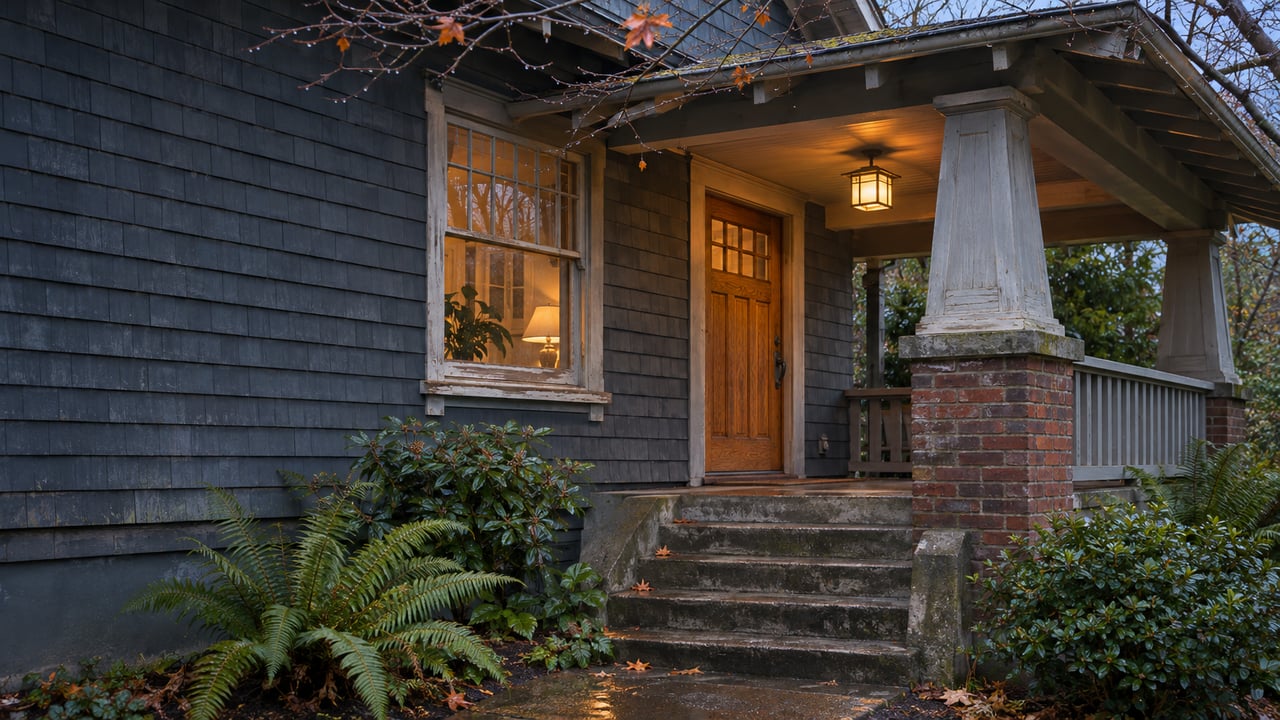
"After we put our down payment, we don't have money left to conduct those repairs." The Seattle Times heard that from buyers in a November 6 story about this fall's housing market. The home in question was a four-bedroom in Kirkland with a dated furnace and water heater. The same story said turnkey homes still get buyers excited, while homes that need repairs can linger.
Much of Madrona and Leschi was built in the early 1900s on hillsides above Lake Washington, and houses of that age are the kind that tend to come with a repair list. When buyers are scarce and short on repair cash, the houses with known work are the ones that wait longest for an offer. This winter, the buyer with a repair estimate and the cash to cover it is the one sellers have to work with.
The October median rose, but prices were flat for the year
The nearest published NWMLS figures come from King County map area 390, which NWMLS labels "Central Seattle." It covers a wider area than these two neighborhoods, so treat it as the backdrop for the central city rather than a count of Madrona and Leschi sales. The October 2026 headline suggests a strong month. The area 390 residential median sale price was $1,250,000, compared with $1,159,475 in October 2025.
That jump came from a small month, not from rising values. Area 390 closed 67 house sales in October 2026, and the average sale price that month was $1,744,130. A few expensive closings in a thin month will push the median up. The year-to-date figures cover far more sales, and they're flat. The median for January through October 2026 was $1,160,000, compared with $1,169,500 for the same months of 2025.
Volume and speed tell more. Area 390 recorded 596 house sales from January through October 2026, against 688 in the same stretch of 2025, about 13% fewer. Average time on market for those year-to-date sales rose to 34 days from 28. So for most of 2026, Central Seattle houses held their prices with fewer buyers, and the buyers took longer to commit.
Homes for sale are piling up because buyers are slower
Citywide, the October 2026 numbers are weaker. Seattle's residential median was $982,500 in October, down 6.43% from October 2025, with 3.28 months of inventory. Area 390 houses had 3.87 months of inventory in October, so the inner city has a little more room than Seattle as a whole.
The NWMLS October report, published November 5, says where that room is coming from. Inventory across the NWMLS service area was 23,519 listings in October, up 25.2% from a year earlier. New listings were unchanged year over year at 7,991. The same number of sellers listed this year as last. Homes are stacking up because fewer of them are selling.
The Seattle Times story makes the same point. King County pending single-family sales in October 2026 were down 16% from October 2025. The paper noted that fall and winter are usually slow, but that a drop this size is about more than the season. It also cited an industry estimate of 97% more sellers than buyers across King and Snohomish counties this fall, or about two sellers for every buyer, up from about 15% more a year earlier. An economist quoted in the piece said buyers "have a lot of room to negotiate."
Put flat prices together with slower sales and the turnkey-versus-repair split, and you get a lopsided market. Move-in-ready homes still draw buyer interest, while homes that need work are the ones that can linger.
Madrona and Leschi's oldest houses are the ones that need work
In Madrona, what you're bidding on goes back to how the hill was built. HistoryLink traces the core of Madrona's hill properties to the Randell family's 1890 homestead near 34th Avenue and Union Street, the same corner where the Union Trunk Line trolley began its run down to Madrona Park. Early in the 1900s, grand homes went up along 35th Avenue at the top of the hill, more were built on the slopes above the beach, and working-class houses were built on a large scale alongside them.
Leschi has a similar mix on steeper ground. HistoryLink's Leschi history describes hillsides and ravines that were once reached by cable car, with Henry Seaborn's marina opening north of Leschi Park in 1905. In 1975, architects Folke Nyberg and Victor Steinbrueck inventoried the buildings for Historic Seattle and found Victorians, bungalows, colonials, Tudor cottages, California cottages, ranch houses and early Northwest regional designs. The Seattle Times once pointed to an 1883 Greek Revival house as an example of that range.
A house like that can take years of steady upgrades. Seattle Met profiled a 1916 Leschi foursquare bought in 2003. Its owners planned to stay five years and ended up doing a full remodel that took about a year. When you tour one of these houses, a lot of what you're pricing is everything earlier owners did or didn't get to.
The usual repairs, with dated costs
Every house is different, but older Seattle houses tend to come with the same short list of big-ticket items. Here is each one with a dated figure you can bring to a showing:
- Oil heat. The City of Seattle's Clean Heat program estimates that 8,000 to 10,000 Seattle homes still heat with oil, down from about 18,000 in 2018, and the City's goal is to move all of them off oil by 2030. Its current page lists a $2,000 instant rebate for switching from oil to a qualifying heat pump. Seattle City Light lists separate contractor discounts of $300, $400 or $600 on qualifying air-source heat pumps, depending on efficiency tier.
- The oil tank itself. A June 2026 estimate from Titan Inspection Services puts decommissioning a clean tank in place at $700 to $1,000 and removing a clean tank at $5,000 to $10,000. It puts typical cleanup at $10,000 to $15,000 when the soil is contaminated.
- The side sewer. A February 2026 estimate from Brewer Sewer puts full side-sewer replacement in Seattle at $10,000 to $32,000. The low end is trenchless lining and the high end is open excavation.
- Seismic retrofit. An October 2025 estimate from CG Engineering gives a typical range of $7,000 to $12,000 for retrofitting a Seattle house.
The three private estimates are contractor and engineering-firm ranges, not set prices. Still, adding them up shows how much a house's condition can shift the price. A clean tank decommissioned in place, a lined sewer and a basic retrofit come to about $17,700. A tank removal, an excavated sewer and a retrofit at the high end come to about $54,000, before a heat pump is installed. On a Central Seattle house that sold for close to the $1,160,000 year-to-date median, that's roughly 1.5% to 4.7% of the price. In a market with fewer buyers than sellers, many of those buyers have also spent their cash on the down payment, and that range is where the negotiating room is.
These figures are general information, not legal, tax or financial advice. Rebates, estimates and their terms change, so check your own situation with the right professional before you count on any of them.
Deciding what kind of buyer to be
The turnkey house in Madrona or Leschi is the part of this market that's still competitive. Prices across area 390 held for the year, and move-in-ready homes are still drawing buyers even as listings pile up. If you need to move in without a project, plan on competing with whoever else is touring that weekend.
The house with a list of known work sits in the other part of the market. A seller who is watching days on market and has seen the same buyers say they can't afford repairs has a reason to accept a lower price or a credit at closing. Your offer is stronger when it shows that you know what the work will cost, rather than guessing at it. A sewer scope, a tank sweep and a structural look before you make an offer turn a vague worry into a dollar figure, and our pre-inspection guide for Leschi and Madrona covers how to plan those visits. Whether a hillside house or a house near the lake fits your plans also affects which repairs you're likely to face, and our comparison of the two goes through that.
Timing matters too. Winter is when these old houses get the fewest showings and when sellers have watched the year-to-date numbers stall. Once the spring listings arrive, more buyers will be back in the market. Until then, a buyer who has already priced the work list is competing with fewer people.
If you're looking at a Madrona or Leschi house built before your grandparents were, I'd like to walk it with you and turn its repair list into numbers before you write an offer. Visit Terry McMahan at homebysix, see how I work with buyers, or start with the home valuation tool to request your personalized home valuation and see what the comparable sales say.